Space not available
Reserve this advertising space
Selected ad format
The file format is not recognized
Click here for
upload an ad
Click here to download
an announcement
Here drag and drop or
upload an ad
Send the ad up to 8 days after payment
A link will be sent to you by contact@via-agency.media
Reserved space
Announcement transmitted
Reference
– Agro-industries, an important sector in job creation
This sector, encompassing both primary processing activities and food processing activities, is the one that contributes the most to the production of added value in exports.
Space not available
Reserve this advertising space
Selected ad format
The file format is not recognized
Click here for
upload an ad
Click here to download
an announcement
Here drag and drop or
upload an ad
Send the ad up to 8 days after payment
A link will be sent to you by contact@via-agency.media
Reserved space
Announcement transmitted
Reference
Agricultural, forestry, and fisheries exports represent the largest share of value added directly generated by labor (24.11 TFPs), while food processing represents the largest share of value added indirectly generated by labor across all exports (21.31 TFPs). Foreign direct investment (FDI) in natural resource exploration is focused on developing the agri-food sector in niche markets. Four sub-sectors with their own dynamics have been identified by the World Bank (February 2020 Memorandum):
– The so-called traditional agri-food industry exhibits strong resilience and significant potential, but also a high degree of concentration and risks of cartelization; this is the case for the vanilla and lychee sectors; ;
– New high-value agri-food niches using the origin of Madagascar as a source of differentiation on the market, presenting a strong potential for territorial inclusion and development of contract farming; this is the case for cocoa, specialty honeys and essential oils; ;
– Other niche exports of high-quality products such as shellfish and tropical exotic fruits, which are based in specific regions and require specialized cold chain logistics; ;
– Emerging agri-food companies geared towards the domestic market, such as poultry, beef and local rice, which are relatively easier to challenge and, therefore, open to investors.
With the expansion of the economy and the increase in urban demand for quality products, a growing number of national and international supermarkets have opened in Madagascar, which is another example of FDI seeking a market.
Funded by the African Development Bank (AfDB), the Southwest Agro-Industrial Processing Park (PTASO) is a 25-hectare project to be established in the commune of Betsinjaka in southwestern Madagascar. Purchasing offices for goods and raw materials to be processed will be set up there. Dried grains, corn, and cassava, which are abundant in the region, will be processed in this park. Seafood processing plants will also be established, creating a type of industry that does not yet exist on the island. Numerous infrastructure projects will accompany the establishment of PTASO. A power plant to supply the industrial zone is already in place on the site.
Space not available
Reserve this advertising space
Selected ad format
The file format is not recognized
Click here for
upload an ad
Click here to download
an announcement
Here drag and drop or
upload an ad
Send the ad up to 8 days after payment
A link will be sent to you by contact@via-agency.media
Reserved space
Announcement transmitted
Reference
Sugar production
Today, Madagascar imports 100,000 tons of sugar annually, while its total consumption is 195,000 tons. The Malagasy Sugar Agricultural Company (SASM), formerly SIRAMA, has officially resumed operations. The government aims to eliminate sugar imports by developing more sugar processing facilities within the country. The objective is to reduce retail prices and benefit the population. SASM's production is estimated at 1,600 tons per year. The resumption of operations will also create approximately 1,600 direct and indirect jobs in the region, support 800 sugarcane farmers, and ensure the production of 15,000 tons of organic sugar, which is in high demand on the international market. Economically, it should also boost domestic trade. In addition, other sugar factories are expected in the coming months in three regions of Madagascar, in order to increase production and eventually export Malagasy sugar to the international market.
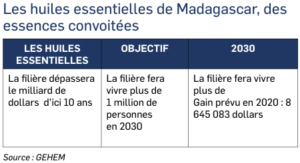
Madagascar offers favorable ecological conditions for the cultivation of aromatic plants and the production of high-quality essential oils. The Great Island boasts highly diverse ecosystems and exceptionally rich natural resources. It possesses sites with high biodiversity potential and a predominance of flora, with an endemism rate exceeding 80%.
In 2017, the country recorded 10,000 endemic plants, including 71 known aromatic species, 30 of which are endemic. Essential oils from Madagascar are highly sought after. Exported to major international brands, these oils are generating increasing demand on the global market. The therapeutic properties of Malagasy plants place essential oils from Madagascar at the forefront of the world. 951,000 tons of the country's production are destined for export. Ravintsara, Mandravasarotra (saro), and Ylang-ylang essential oils, staples of the sector, are particularly coveted by investors.
Ylang-ylang essential oil is widely used in perfumery, cosmetics, and homeopathy. Its floral and jasmine-like notes attract the biggest names in the perfume industry. It also possesses anti-inflammatory properties, presenting an opportunity for investment in the pharmaceutical industry.
Space not available
Reserve this advertising space
Selected ad format
The file format is not recognized
Click here for
upload an ad
Click here to download
an announcement
Here drag and drop or
upload an ad
Send the ad up to 8 days after payment
A link will be sent to you by contact@via-agency.media
Reserved space
Announcement transmitted
Reference