


Many sectors, such as tourism, agriculture, agribusiness, and telecoms, are looking to the sector's development to boost their growth. For businesses, power outages are a source of additional costs, with outages forcing economic operators to resort to generators. Furthermore, Madagascar's energy costs, one of the most expensive in Africa, are damaging its competitiveness as an investment destination. Unstable and expensive energy remains a barrier to investment. However, Madagascar has considerable renewable energy potential (hydroelectric, solar, wind) that has not yet been sufficiently exploited. Under the General State Policy (PGE) and the National Plan for the Emergence of Madagascar (PEM), the plan is to achieve an electrification rate of 50% by 2023 and 70% by 2030.
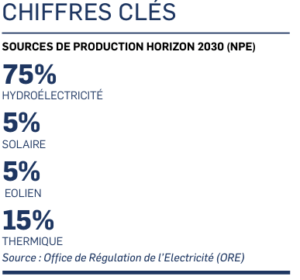 Access for all to reliable, sustainable, and affordable energy services is a prominent feature of the seventeen objectives set out in the 2015 New Energy Policy (NEP), which established the framework and objectives for the deployment of renewable energy. Since 2017, the new Electricity Code has brought about a simplification of procedures and the strengthening of market liberalization, particularly in the areas of transmission and distribution.
By developing its hydroelectricity, Madagascar is reducing its dependence on fossil fuels, the cost of importing which weighs significantly on the country's economy and the financial viability of JIRAMA, the national water and electricity company.
Through the Ministry of Energy, the Rural Electrification Development Agency (ADER) implements the electricity subsector policy in rural areas. ADER develops projects based on indicative master plans in the 22 regions. It promotes economically viable, competitive, and more efficient alternative energy sources to serve households and production units while developing the public-private partnership system by mobilizing all the financial resources necessary to finance investments.